Introduction
Many founders only start asking how to register a trademark internationally when they get a nasty surprise. An Indian startup spends years building a name, starts exporting or selling on a big marketplace, and then discovers that the same brand is already registered in the United States or Europe. In some cases, a local company has even filed that mark first and now threatens legal action.
The hard truth is simple: trademark rights are territorial. A registration in India gives rights only inside India. It does not protect the brand in the US, UK, EU, or any other foreign market, and there is no single “world trademark” that covers every country at once.
“A trademark is a sign capable of distinguishing the goods or services of one enterprise from those of other enterprises.” — World Intellectual Property Organization (WIPO)
So the real question is not whether to learn how to register a trademark internationally, but which path to use and when to start. For Indian businesses, there are two main methods:
The first is the Madrid Protocol, where one application can cover many member countries.
The second is direct national filing, where you file separate applications in each country.
As a Registered Trademark Attorney, I wrote this guide for 2026 to make these options clear and practical. By the end, you will understand eligibility under the Madrid Protocol, the exact steps to file, how it compares with direct filing, the main risks to avoid, and what to do after registration. That way, you can protect your brand abroad with confidence instead of reacting to problems later.
Key Takeaways
International trademarks are not automatic, so learning how to register a trademark internationally is essential for any brand that wants customers outside India. Protection must be secured in each market through the Madrid Protocol, direct filing, or a mix of both methods.
India is a member of the Madrid Protocol, which lets an Indian owner file one application to cover many countries. A strong Indian basic mark and a clear list of goods and services are needed before using this system in a safe and effective way.
Direct national filing gives full independence from the Indian application, which can help when the home mark is risky. This path often costs more at the start, but it offers more control over how the mark is handled country by country.
Post‑registration tasks such as renewal, expansion to new countries, and watching for infringers are just as important as the first filing. Without this follow‑up work, even a well planned international filing can lose its value.
Professional guidance from a trademark attorney can prevent simple filing errors, missed deadlines, and weak protection that later becomes very expensive to fix.
Why International Trademark Registration Matters For Indian Businesses

For many Indian businesses, international expansion does not start with an office abroad. It starts when export orders appear, overseas distributors call, or foreign customers begin placing online orders. At that moment, not knowing how to register a trademark internationally can turn into a very real business risk.
Key threats include:
Brand squatting
A foreign distributor, competitor, or even an unknown person might quickly register “your” brand in their country before you do. Once that happens, removing or buying back that registration can be slow, complex, and expensive. In some cases, the brand owner from India is forced to rebrand for that market.E‑commerce confusion
Online marketplaces mean your products can reach buyers around the world, even if you never set up a foreign office. If your mark is not protected in key markets, others may copy your name on the same platforms where you sell. This confuses buyers, drains sales, and damages trust, even when the fake products are of poor quality.Counterfeit goods
Counterfeiters actively look for brands that are well known in one country but unprotected in another. Without international registration, stopping fake goods at foreign customs, on marketplaces, or through courts becomes much harder. A registered mark gives a legal base to act quickly.
On the positive side, an international trademark registration is also a real business asset. It supports licensing, franchising, and joint ventures because partners abroad can see your rights clearly. Indian brands such as Micromax have used international filings to protect their marks in many countries while scaling abroad.
“An ounce of prevention is worth a pound of cure.” — Benjamin Franklin
This old saying fits trademark strategy perfectly: filing early usually costs less than fighting later.
From my experience, early action is far cheaper than cleaning up later. Learning how to register a trademark internationally, even for a small set of target countries, can protect export plans, brand value, and negotiation power for years.
Two Primary Methods The Madrid Protocol Vs. Direct National Filing

When a business in India decides to learn how to register a trademark internationally, it soon discovers that there is no single worldwide registration. Protection has to be built country by country, or through structured systems that bundle countries together.
The first method is the Madrid Protocol. This system is run by the World Intellectual Property Organization in Geneva. India joined in 2013, and since then Indian owners can file one international application in English through the Indian Trade Marks Registry, which acts as the Office of Origin — a process explained in detail via the Madrid System: Filing International Trademark Applications guide published by WIPO. With this route, a single application can extend to more than one hundred member countries.
The Madrid Protocol keeps many tasks in one place. Changes of ownership, renewals, and later expansion to more member countries can all be handled through a central portal. For a startup that wants protection in several Madrid member states, this often feels simpler than working with many separate agents.
The second method is direct national filing. Here, you file a separate application in each target country’s trademark office, usually through a local trademark attorney. This is the only way to register in countries that are not part of the Madrid system, including some in the Middle East and South America. It often costs more at the start but does not depend on the Indian application.
This quick table sums up the key differences:
| Feature | Madrid Protocol | Direct National Filing |
|---|---|---|
| Cost at start | Usually lower when covering many countries | Usually higher because each country is separate |
| Process | One application, one main set of fees | Many applications in many offices |
| Countries included | Only Madrid member countries | Any country worldwide |
| Dependence on Indian mark | High during first five years | None |
| Ongoing management | Central record with WIPO | Handled country by country |
In practice, many Indian businesses use a mix of both methods, based on where they plan to trade and how strong their home mark is.
How To Register A Trademark Internationally Via The Madrid Protocol Step‑By‑Step
If you are based in India and want a practical answer to how to register a trademark internationally in many countries at once, the Madrid Protocol is often the starting point — and this Guide to Register an International Trademark offers a complementary breakdown of the key practical concerns for 2025. The process may look complex at first, but it follows a clear order once the basics are in place.
Eligibility Requirements For Indian Applicants
Only certain applicants from India can use the Madrid system. There must be a real link with India, and there must be a basic mark that acts as the foundation.
In simple terms, you must:
Have a connection with India
The owner should be an Indian national, live in India, or have a real and effective industrial or commercial place of business in India.Own a basic mark in India
This is a pending application or registration filed in India using Form TM‑A. The international mark must match this basic mark exactly, including spelling, logo style, and any colour claim. It is not possible to improve or modify the mark only for the foreign filing.Keep the same or narrower goods and services
The list of goods and services in the international application must not be broader than the Indian list. It can be the same or narrower, but never wider.Select Madrid Union member countries
At the time of filing, the applicant must choose one or more Madrid Union member countries in which protection is requested. These choices decide much of the cost.
The 7‑Step Registration Process
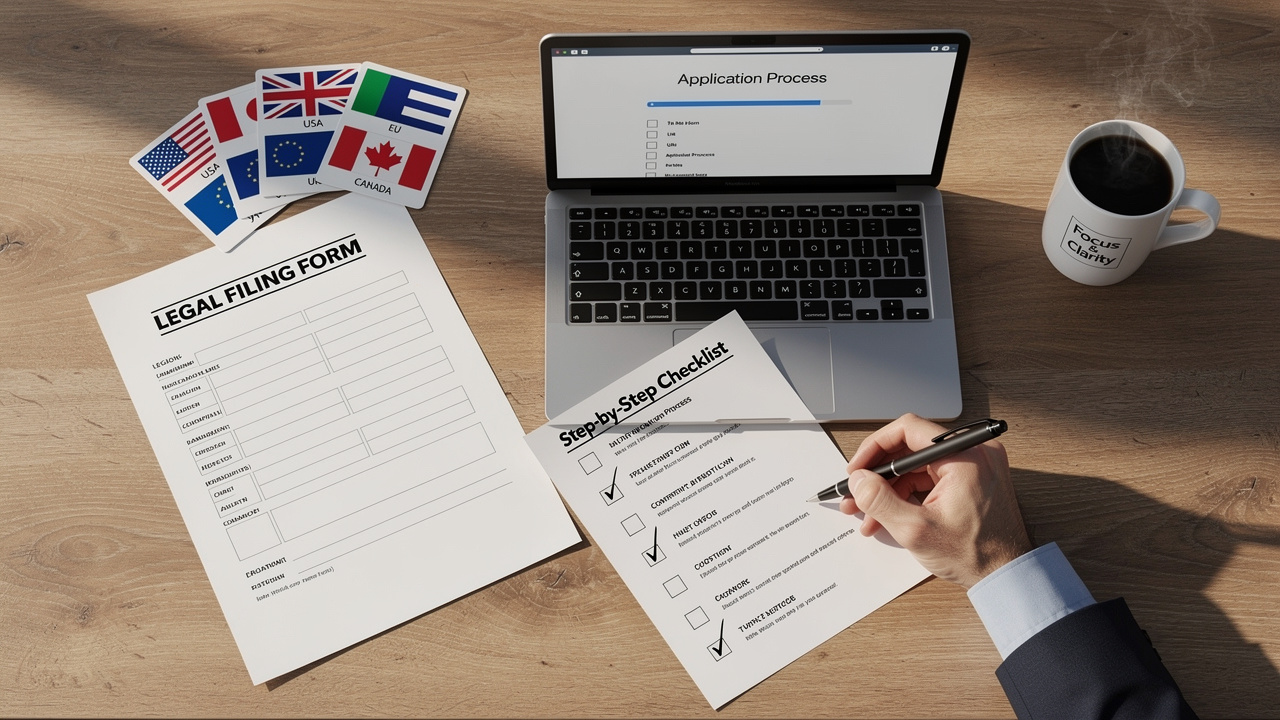
Once you meet the conditions above, you can follow this step‑by‑step process for how to register a trademark internationally under the Madrid Protocol. Each step builds on the last, so the order matters.
Step 1 – File Your Basic Mark In India
You begin by filing Form TM‑A with the Indian Trade Marks Registry for your brand. This filing creates the basic mark that will support every later designation through Madrid. Without this Indian base, you cannot move to an international application under this system.Step 2 – Conduct A Global Trademark Search
Before filing abroad, you should search for similar marks in each target country. Tools such as the WIPO Global Brand Database and local registers give a first view of possible conflicts. This effort reduces the risk of easy refusals and helps you decide where it makes sense to apply.Step 3 – File The International Application Using Form MM2E
After filing the basic mark, you can submit Form MM2E through the IP India portal. In this form, you select the Madrid member countries and confirm the goods and services. At this point, you pay a handling fee to the Indian Registry and the main fees to WIPO, which include one basic fee plus an amount for each country.Step 4 – Wait For Certification By The Indian Registry
The Indian Trade Marks Registry checks whether the details in Form MM2E match the basic mark exactly. If something does not match, the office sends an irregularity notice and asks for correction. Once all details are aligned, the office certifies the application and forwards it to WIPO.Step 5 – Undergo Formal Examination By WIPO
WIPO then reviews the application for formal points such as correct classification and full payment. WIPO does not judge whether the mark is distinctive in each country. If all is in order, WIPO records the mark in the International Register, publishes it in the WIPO Gazette of International Marks, and informs each chosen country.Step 6 – Face Substantive Examination By Designated Countries
Every country you selected now examines the mark under its own national law. Offices check for conflicts with earlier marks and for basic rules such as descriptiveness or forbidden terms. Each office usually has twelve to eighteen months to accept the mark or issue a provisional refusal.Step 7 – Respond To Refusals Through Local Counsel
If a foreign office issues a provisional refusal, you must reply directly to that office within its set time limit. In almost all cases, you will need a local trademark attorney in that country to argue, amend, or appeal. WIPO does not assist with these replies, so planning and local help are very important.
When no refusal is issued within the time limit, or when any refusal is overcome, the mark gains protection in that country. The international registration lasts ten years from the filing date and can be renewed for further ten‑year periods directly with WIPO.
Key Risks And Considerations Before You File

Before deciding how to register a trademark internationally, it helps to understand the main risks that I see in practice. A thoughtful plan at this stage can save a lot of time and money later.
Risk 1 – Central Attack Under The Madrid Protocol
For the first five years, the entire international registration depends on the Indian basic mark. If the Indian application is refused, withdrawn, limited, or cancelled in that time, the linked international registration is cancelled to that same extent. This is why I strongly suggest making sure the Indian mark is distinctive and well searched before relying on it for many foreign filings.Risk 2 – Cost Of Local Counsel
While Madrid keeps the first filing in one place, any refusal or opposition in a foreign office must be handled locally. Hiring attorneys in multiple countries on short notice can become costly. It is wise to keep a budget line for possible foreign objections.Risk 3 – Countries Outside The Madrid System
Madrid does not cover every country. If one of your main export markets is outside the Madrid Union, then that registration must be handled by direct national filing. Many Indian brands use Madrid for some countries and direct filing for the rest, so a mix of both methods is common — an approach explored in depth in this guide on Registering Trademark Internationally with practical insights from a trademark attorney.Risk 4 – Fee Structure And Cash‑Flow Planning
Each designated country charges its own fee, which can vary a lot from one office to another. Adding many high‑fee countries in one go can stretch a young company’s budget. Selecting core markets first and adding others later through subsequent designations often works better.Risk 5 – Common Filing Mistakes
Frequent errors include filing with a weak descriptive mark, copying the exact Indian goods list without adapting strategy, or skipping thorough searches abroad. As a Registered Trademark Attorney, I create educational content to help owners spot these issues before they press submit.
“The difference between a registered trademark and an unregistered name often shows only when there is a dispute — and by then, it may be too late to fix cheaply.” — Practical lesson from my work with Indian founders
Conclusion

Choosing how to register a trademark internationally is as much a business decision as a legal step. For many Indian entrepreneurs, the Madrid Protocol offers a simple way to cover several member countries with one filing. For others, direct national filing gives better control and less dependence on the Indian application.
The right path depends on where the business will trade, how strong the Indian mark is, and how much can be set aside for both filing and later defence. Either way, international registration protects more than a name. It protects future revenue, brand value, and access to foreign markets.
My suggestion is to start with a clear global trademark search, think through your priority countries, and then discuss the plan with a professional. If you want more practical guidance, you can explore the educational resources I share as Advocate Rajesh Arya, where I break down international trademark strategies for Indian founders and small businesses.
FAQs
Question 1 – Is There A Single Trademark That Covers All Countries In The World?
There is no single worldwide registration that covers every country. Trademark rights are territorial, so protection has to be secured in each country or through systems that group countries. The Madrid Protocol lets you file one application that can cover more than one hundred member states, and regional systems such as the European Union trademark cover all EU members.
Question 2 – How Long Does International Trademark Registration Take Through The Madrid Protocol?
After certification by the Indian office, WIPO usually records and publishes the international registration within one or two months. Each designated country then has around twelve to eighteen months to examine the mark and either accept it or issue a provisional refusal. Some countries decide quickly, while others use most of this period. If objections arise, the timeline extends while the responses are handled.
Question 3 – How Much Does It Cost To Register A Trademark Internationally From India?
The cost of how to register a trademark internationally from India depends mainly on three factors:
the number of countries you choose
the number of classes of goods and services
the country‑by‑country fees set by each office
WIPO charges a basic fee plus a fee for every designated country, and the Indian Registry charges a handling fee. If any foreign office issues a refusal, extra costs for local attorneys also need to be added.
Question 4 – What Happens If My Indian Trademark Application Is Rejected After I Have Filed Internationally?
If your international registration is based on a Madrid Protocol filing and the Indian basic mark is refused, withdrawn, or cancelled within five years, the international registration is affected to the same extent. This event is called central attack and can cancel protection in all designated countries. After five years, the international registration becomes independent from the Indian mark, which is why I always suggest building the foreign plan on a strong, distinctive Indian application.